Schizophrenia and Negative Symptoms: Q&A with Dr. Potkin

2013, Abilify, affective flattening, alogia, Anti-anxiety meds, Anti-depressants, Anti-psychotics, asociality, avolition, Biology, Bipolar, Brain, Depakote, Depression, dopamine hypothesis, Dr. Steven G. Potkin, drugs, Education, Genentech, Geodon, Haldol, Haldol DEC, Haldol Decanoate, Health, insanity, Irvine (UCI), Kristin Bell, Lithium, Mania, Manic, Medicine, Mental Health, Mental Illness, Mood Stabilizers, N-methyl-D-aspartate, NAMI, negative symptoms, neuron, neuroscience, neurotransmitters, NMDA, NMDA receptor hypofunction hypothesis, Paranoid Schizophrenia, Paxil, Prescription Meds, Psych Meds, Psychiatrist, Psychiatry, Psychiatry Denial, Psycho, Psychoactive Substances, psychoanalysis, Psychology, Psychosis, Risperdal, schizoaffective disorder, Schizophrenia, Science, Seroquel, stigma, Support System, Surviving, symptoms, synapse, sz, Therapist, Trazadone, treatment, treatment-resistant, Trilifon, Wellbutrin, Zoloft, Zyprexa

negsymp I have some great news! I was able to ask Dr. Steven G. Potkin, Professor of Psychiatry in the Department of Psychiatry and Human Behavior at the University of California, Irvine (UCI) Medical Center, some questions regarding the negative symptoms of schizophrenia. He is also the Robert R. Sprague Endowed Chair in Brain Imaging. It was a brief, by email interview, but I’m happy to share what I’ve learned with you all! The following is the Q&A:

Kristin: What are negative symptoms?
Dr. Potkin: “Negative” does not refer to a person’s attitude, but instead to a lack of characteristics that should be present. Symptoms include reduced amount and content of speech, even when encouraged to interact (alogia), lack of emotional and facial expression (affective flattening), diminished ability to begin and sustain activities (avolition), decreased ability to find pleasure in everyday life (anhedonia) and social withdrawal (asociality). [1] [2]

Negative symptoms can appear a few years before other symptoms appear in young adulthood in the so-called “prodromal” stage of the illness.[3] Unfortunately these symptoms often go undetected because they manifest themselves as issues common among teenagers: social withdrawal, problems with school work, irritability, depression and sleeping problems.[4]

Kristin: Do all people with schizophrenia have negative symptoms?
Dr. Potkin: No, but at any point in time, negative symptoms can affect approximately 50 percent or more of people with schizophrenia.[5] [6]

Kristin: How do negative symptoms affect a person with schizophrenia? How do they affect their family and friends?
Dr. Potkin: Research suggests that for people living with schizophrenia, negative symptoms are key factors in poor quality of life as well as problems with personal hygiene, school and work performance, maintaining relationships, interacting within the community, and participating in social activities. [7] [8] [9] [10]

For caregivers of people with schizophrenia, negative symptoms may cause more burden than do other types of symptoms as they see their loved ones life isolated and lacking in meaning or joy. [11]

Kristin: How are negative symptoms currently treated?
Dr. Potkin: Current treatments for schizophrenia focus on reducing characteristic symptoms and can include both medication and psychosocial interventions.[12] No effective medication treatment has yet been approved for specific treatment of negative symptoms. Despite progress in the medication side of treatment, there are still unmet needs in terms of symptom control. A large study found that despite treatment, approximately 57 percent of people receiving treatment for a schizophrenia spectrum disorder still had at least one negative symptom.[10]

Kristin: What is the research that Genentech is doing regarding negative symptoms?
Dr. Potkin: Researchers at Genentech are pursuing new treatment strategies for schizophrenia, including increasing N-methyl-D-aspartate (NMDA) receptor activity in the brain in order to target the mechanism that may be a common link between the positive, negative and cognitive symptoms of the disorder.[7] [9] [11] [12]

Specifically, through a clinical trial program, Genentech is looking at an investigational medication for people with schizophrenia, including people who experience mostly negative symptoms of schizophrenia, despite taking medication. For more information, please visit www.SearchLyteschizophrenia.com

Kristin: How can family and friends of someone with schizophrenia help someone with negative symptoms?
Dr. Potkin: Caregivers can talk to doctors about interventions including medication, psychosocial rehabilitation (work, school, relationships), medical care and wellness, and therapy (e.g. cognitive behavioral therapy and peer support groups), as well as ongoing clinical trials.[13] They can work with physicians to find the medications and non-medicine therapies that are right for their loved one. Different medicines may have different side effects. Caregivers can also consider programs from the National Alliance on Mental Illness (NAMI) including:

• NAMI Hearts and Minds

– Online, interactive wellness initiative

www.nami.org/heartsandminds

• NAMI Peer-to-Peer

– Free, 9-week educational course on recovery

www.nami.org/peertopeer

• NAMI Connection

– Recovery support group for adults

www.nami.org/connection

Kristin: Do scientists know the biological mechanisms involved in negative symptoms? If so, what are the areas of the brain and/or mechanisms involved in negative symptoms?
Dr. Potkin: In the 1970s, the “dopamine hypothesis” of schizophrenia emerged, suggesting the biological basis of schizophrenia was an excess of signaling by dopamine, a chemical messenger in the brain. This theory, however, could not explain negative or cognitive symptoms.[6] In the late 1980’s a newer theory suggested positive, negative and cognitive symptoms could all be due to reduced function of NMDA receptors in the brain. This theory is now known as the “NMDA receptor hypofunction hypothesis.”[6] [7] [8] [9]

Researchers are pursuing new treatment strategies for schizophrenia, including increasing NMDA receptor function in the brain in order to target the mechanism that may be a common link between the positive, negative and cognitive symptoms of the disorder.[7] [9] [11] [12] It is thought that NMDA receptor activity is an important pathway in psychiatric disorders, especially schizophrenia.

End of article.

*Note: I would like to thank Dr. Potkin for helping me put together this interview. This research is very exciting and I hope that negative symptoms can be tackled in this decade! I know how debilitating they can be!

______________________________

1.     Gard DE, Kring AM, Gard MG, Horan WP, Green MF. Anhedonia in schizophrenia: distinctions between anticipatory and consummatory pleasure. Schizophr Res. Jul 2007;93(1-3):253-260.

2.     Strauss GP, Gold JM. A new perspective on anhedonia in schizophrenia. Am J Psychiatry. Apr 2012;169(4):364-373.

3.     Stahl SM. Stahl’s Essential Psychopharacology: Neuroscientific Basis and Practical Applications. 3rd ed. New York: Cambridge University Press; 2008.

4.     National Institute of Mental Health. Schizophrenia. 2009; http://www.nimh.nih.gov/health/publications/schizophrenia/complete-index.shtml. Accessed July 7, 2012.

5.     Kirkpatrick B, Fenton WS, Carpenter WT, Jr., Marder SR. The NIMH-MATRICS consensus statement on negative symptoms. Schizophr Bull. Apr 2006;32(2):214-219.

6.     Bobes J, Arango C, Garcia-Garcia M, Rejas J. Prevalence of negative symptoms in outpatients with schizophrenia spectrum disorders treated with antipsychotics in routine clinical practice: findings from the CLAMORS study. J Clin Psychiatry. Mar 2010;71(3):280-286.

7.     Ho BC, Nopoulos P, Flaum M, Arndt S, Andreasen NC. Two-year outcome in first-episode schizophrenia: predictive value of symptoms for quality of life. Am J Psychiatry. Sep 1998;155(9):1196-1201.

8.     Kirkpatrick B, Fenton WS, Carpenter WT, Jr., Marder SR. The NIMH-MATRICS consensus statement on negative symptoms. Schizophr Bull. Apr 2006;32(2):214-219.

9.     Kurtz MM. Symptoms versus neurocognitive skills as correlates of everyday functioning in severe mental illness. Expert Rev Neurother. Jan 2006;6(1):47-56.

10.   Milev P, Ho BC, Arndt S, Andreasen NC. Predictive values of neurocognition and negative symptoms on functional outcome in schizophrenia: a longitudinal first-episode study with 7-year follow-up. Am J Psychiatry. Mar 2005;162(3):495-506.

11.   Provencher HL, Mueser KT. Positive and negative symptom behaviors and caregiver burden in the relatives of persons with schizophrenia. Schizophr Res. Jul 25 1997;26(1):71-80.

12.   National Institute of Mental Health. Schizophrenia. 2009; http://www.nimh.nih.gov/health/publications/schizophrenia/complete-index.shtml. Accessed July 7, 2012.

13.   National Institute of Mental Health. Schizophrenia. 2009; http://www.nimh.nih.gov/health/publications/schizophrenia/complete-index.shtml. Accessed July 7, 2012.

Sign the Petition to Increase Funding for Research for Mental Illness

Anti-depressants, Anti-psychotics, Anxiety, Bipolar, congress, cure, democrat, Depression, Health, Kristin Bell, Mental Health, Mental Illness, petition, politics, POTUS, President, Psych Meds, Psychiatrist, Psychiatry, Psychiatry Denial, Psycho, Psychoactive Substances, Psychology, Psychosis, republican, Research, schizoaffective disorder, Schizophrenia

Screen shot 2012-12-29 at 4.50.31 PM

Hi! Just wanted to post this to ask people to please sign the petition to the President and Congress to increase funding for research related to finding cures for mental illness. It only takes a minute! Please share with your friends too!

https://www.change.org/petitions/to-the-president-and-congress-fund-research-to-cure-mental-illness

BTW: Save Your Pennies and Make Change! :)

Bipolar, Bring Change 2 Mind, Collection, Depression, Kristin Bell, Licoln, Mental Health, Mental Illness, Pennies, Psych Meds, Psychiatrist, Psychiatry, Psychology, Psychosis, schizoaffective disorder, Schizophrenia, Shame, stigma

Attach this handy printout to a jar and take it into work and/or keep one on hand at home! Change your mind about mental illness and make change at the same time! :)


Bring Change 2 Mind!

2012, Activism, Allies, Anti-anxiety meds, Anti-depressants, Anti-psychotics, awareness, Bipolar, Bring Change 2 Mind, Depression, Kristin Bell, Mental Health, Mental Illness, Mood Stabilizers, neuroscience, Psych Meds, Psychiatrist, Psychiatry, Psychiatry Denial, Psychology, Psychosis, schizoaffective disorder, Schizophrenia, stigma

Hi! As you might know if you have scanned my blog, I make it a point to talk about mental health/illness, because I have schizophrenia and I believe in stomping out the stigma of mental illness. Well, I have this cute story to share! I was waiting outside of the classroom for my biology lab class to start this fall and started talking to a supernice girl who was in my class. We got to talking and to try to explain why I had been in school so long I decided to tell her that I have schizophrenia. Lo and behold she says “oh yah, my mom has bipolar and my brother has schizophrenia too!” What a small world!!! It turns out her whole family is active in the mental health field in advocating for the erasure of stigma related to mental illness and they have a website called http://bringchange2mind.org/ . I am always surprised when I talk to people about my own illness and then they also know someone or are someone with mental illness too! It is such a big thing in peoples’ lives and when we talk about it, it is surprising/amazing/wonderful that we aren’t alone in our struggles. So, I just wanted to share this little story and a link to the Bring Change 2 Mind website. It was a wonderful feeling to meet someone else at school who knows first hand about mental illness and to be able to talk openly about it! :) Three cheers for no more stigma!!! :)

Genetic Testing! Yay!

Abilify, Anti-anxiety meds, Anti-depressants, Anti-psychotics, Anxiety, benadryl, Biology, Bipolar, Body, BPD, Buspar, Depakote, Depression, dna, drugs, Effexor, genetic testing, Genetics, Haldol, Haldol DEC, Haldol Decanoate, Kristin Bell, Lithium, Mania, Manic, Manic-Depressive, MAO Inhibitors, Medicine, Mental Health, Mental Illness, metabolic pathways, metabolize, Mood Stabilizers, Navane, neuroscience, Obsessive-Compulsive Disorder, ocd, Paranoid Schizophrenia, Paxil, plavix, Prescription Meds, Prozac, Psych Meds, Psychiatrist, Psychiatry, Psychoactive Substances, Psychology, Psychosis, Risperdal, schizoaffective disorder, Schizophrenia, Science, Seroquel, Technology, testing, Trazadone, Trilifon, warfarin, Wellbutrin, Zoloft, Zyprexa

http://www.genemedrx.com/

Hey Everybody! I wanted to share with you this cool genetics testing that is available to people. I just got it done, because my nurse practitioner ordered it and Medicare pays for it. (Medicare pays for this testing, because it saves a LOT of money and can save lives!) It is really cool, because it tells you how medications will interact with your specific genetic makeup! It is extremely important if you are taking really any kind of medication. For example, had I known about my results before I took Wellbutrin years ago, it would have saved me from basically having a manic reaction to the medication. It turns out that I metabolize differently than normal on some of the metabolic pathways. This means that I will metabolize the meds on those pathways different than people without this issue. If you have Medicare, I strongly urge you to get this testing done. It could save your life from a bad genetic-medication mistake. I think many other insurance carriers might also pay for it. It also explains why I can take a lower dose of many medications and still get the desired effect from the medication. I would say that anyone who is trying to figure out their psych meds should really get this testing done too. It doesn’t just tell about psych meds though, it tells about stuff involving all other sorts of meds. Seriously, this is pretty awesome! Again, here is the link: http://www.genemedrx.com/

Got My Cure Alliance Schizophrenia Magnet Today! Yay!

Activism, Anti-depressants, Anti-psychotics, Anxiety, Bipolar, Brain, Cure Alliance, Depression, insanity, Kristin Bell, magnet, Mania, Manic-Depressive, Mental Health, Mental Illness, Obsessive-Compulsive Disorder, ocd, Psychiatry, Psychology, Psychosis, schizoaffective disorder, Schizophrenia, sz

Hi! I’m happy to report I got my Cure Alliance schizophrenia magnet today! Strange that my bumper wouldn’t hold the magnet! haha. Anyway, please check them out at the Cure Alliance Facebook page here. Also, see the related post I made about their campaign here.

50-50-50 Magnet Campaign for Mental Illness

Activism, Bipolar, Depression, Kristin Bell, Mental Health, Mental Illness, Obsessive-Compulsive Disorder, Paranoid Schizophrenia, Psychiatry, schizoaffective disorder, Schizophrenia

Hey everybody! The Cure Alliance has launched their 50-50-50 campaign to raise awareness about mental illness. It stands for 50 states, 50 magnets in 50 days. They want to get their mental illness magnets in 50 states in 50 days! YOU can participate! The first person from each state to contact them gets their choice of a free magnet for their car! Just email them at this address: info@curealliance.org. Also, you can buy them from their store HERE. I think they are good for other things too, like to stick on lunchboxes or bikes or anything a magnet will stick to!!! Please also like their Facebook page HERE.

Wonderful Video Documentary About a Mother with Schizophrenia

2012, Acceptance, Activism, Allies, Anti-psychotics, Children, Depression, Discrimination, DSM-5, Education, Families, Family, Grandmother, insanity, Kristin Bell, Mental Health, Mental Illness, Mom, Mother, Motherhood, Prescription Meds, Psych Meds, Psychiatrist, Psychiatry, Psychiatry Denial, Psychoactive Substances, Psychology, Psychosis, schizoaffective disorder, Schizophrenia

I’m taking a Women’s Studies course at school and we are looking at the topic of Motherhood. This week we are discussing motherhood and disabilities, and I came across this wonderful video series that is made by a student about a mother who has schizophrenia and how it has impacted her life and the life of her daughter. I think he did a really good job! The video is divided into four parts and I hope you watch all four parts! :)

http://www.youtube.com/watch?v=Hx6j_Tyb8Uo&feature=share&list=PL81E9C419F7641FD8

Mental Health Update: Monday, May 28, 2012

2012, Abilify, Acceptance, Anti-anxiety meds, Anti-depressants, Anti-psychotics, Anxiety, Autobiography, Bipap, Body Image, Body Narrative, Brain, Buspar, Depression, Diary Rant, EDNOS, Fat, Fat Acceptance, Fat Hatred, Haldol, Haldol DEC, Haldol Decanoate, Happy, Health, Injections, insanity, Kristin Bell, Medicine, Mental Health, Mental Illness, Mood Stabilizers, Prescription Meds, Psych Meds, Psychiatrist, Psychiatry, Psychiatry Denial, Psycho, Psychoactive Substances, Psychology, Psychosis, schizoaffective disorder, Schizophrenia, Sleep, Sleep Disorders, stigma, Weight, Zoloft

I thought I’d do a little mental health update, since it has been quite some time since I’ve blogged about my overall mental health. As some of you dear readers may know, I have schizophrenia. I first had issues with it when I was about 15. My first hospitalization was when I was 16. Towards the end of 2000 I got mostly stabilized with my Haldol injections and Zoloft. I haven’t been in the hospital since then! Yay! Quite a long run I’ve had and I hope it continues! For quite some time I had problems getting things done, being motivated and feeling down…that sort of thing, even though I was mostly fine. I think it was last year that I started taking Abilify and it has made a HUGE difference! I’m still taking Zoloft, Buspar, Haldol and some non-psychiatric meds in addition to the Abilify, but the addition of the Abilify was great. I’m doing really pretty well these days. Sometimes I have anxiety, although I think it might generally be related to performance issues with school. I also tried taking Topamax to help with weight loss, but I thought it might be making me stupid and giving me more anxiety, so I quit taking it. I think overall, the Topamax was not helping. It seemed like I was becoming less motivated and more sad with it. I also had that bad anxiety day that I wrote about recently.

So, I think I was just hoping for a magic weightloss bullet with the Topamax. It didn’t work. Boo. I have lost about 90-100 pounds though which is good, but I still need to be less sedentary. I’m also a believer in fat acceptance, but of course it is hard to say that I never want to try to lose weight. I would be an even bigger believer in fat acceptance if I wasn’t actually fat I think!!! hahaha. I know that sounds ridiculous, but it is kind of true. I can accept the hell out of everyone’s fatness, but my own! lol.

Anyway, enough about fatness for now. What I want to say is that I’m doing well on the whole. My sleep patterns have improved with my sleep apnea machine, and while I’m not sleeping on any kind of normal schedule yet, I’m getting sleep every day and mostly at the same time! I still tend to be somewhat paranoid, but I’ve found that opening up with people over the years on the internet has really helped me to realize that I don’t need to be afraid of everyone in the world. I still have some delusional thoughts that blow through my brain now and then, but I consider them to be more of a slight annoyance than a big deal right now. But seriously, it is because of the medicine. If I wasn’t taking my meds, and doing so faithfully, I would be in and out of hospitals and massively psychotic. Some people don’t believe me, because I “seem so normal,” but I have to wonder what THAT means anyway? And, I don’t know, it seems like I should be insulted when people say that to me, but I’m not sure why I find it so insulting! I don’t necessarily want to be abnormal, even though I pretty much am, but I think it just bothers me that people attach a kind of value judgement to the term “normal” as if “normal” is superior. It is definitely easier to live in the world if you are “normal,” but it isn’t the only way to be in the world, that’s for sure. Normal is just such a peculiar word, no?

So, I’m doing fine. Some anxiety here and there, some weird thoughts here and there…a depressed mood now and then, but mostly just good. Which is nice. Thank you meds and thank you lucky stars! So, that’s my update after living with schizophrenia for 24 years. Wow! 24 years! Man am I getting old!!! LOL.

New Abstract Art by Me + Discussion

abstract art, Art, art journal, Autobiography, Bipolar, Borderline Personality, BPD, DBT, Depression, drawings, EDNOS, Handmade, Hope, Illustrated, insanity, iPad, iPad Art, journal, Kristin Bell, Marsha Linehan, Memory, Mental Health, Mental Illness, Mindfulness, pain, Painting, Photography, process, Prozac, Psych Meds, Psychiatrist, Psychiatry, Psychiatry Denial, Psychoactive Substances, Psychology, Sculpture, Self-Harm, Self-Injury, sketchbook, Stress, Suicide, Support System, Surviving

Process:
I was reading a book by Marsha Linehan, the creator of Dialectical Behavior Therapy treatment for people with Borderline Personality Disorder, and I was struck by the theoretical concepts that she was discussing in the book. At the same time, I had been thinking about my friend who has BPD. I thought about the unending pain she suffers and how there is so much rage and turmoil in her life. I wanted to incorporate both Linehan’s concepts and aspects of my friend into the art journal that I just started working on as a collaboration with my friend, John.

So, John began the journal by preparing many pages and providing inspirations and prompts, then he mailed it to me and it was my turn to lay down something on the pages.

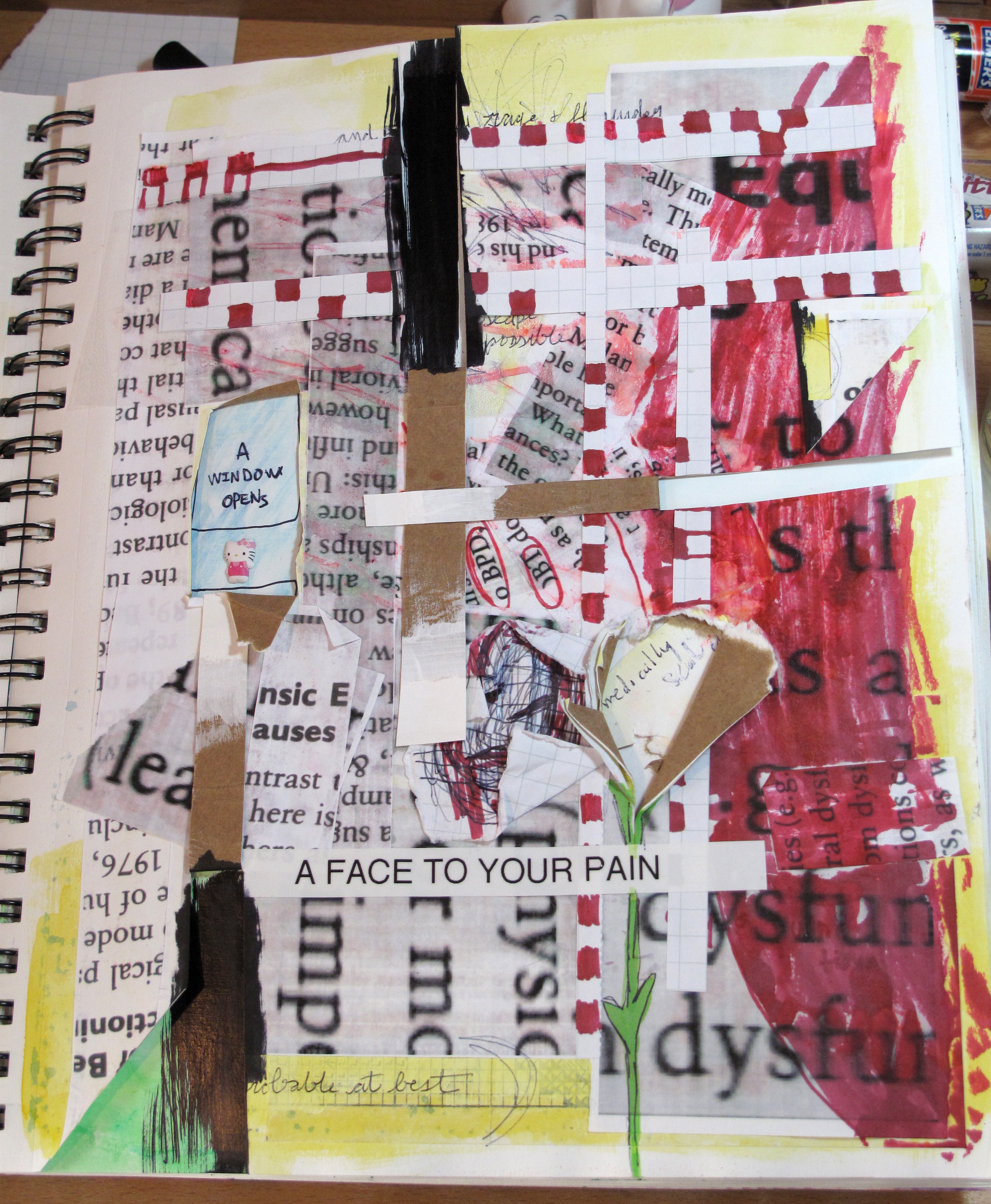
The first thing I did was use a handheld scanning pen to scan vertical snippets of text from the Linehan book. I then printed out the scans and cut them up into various pieces. You can just make out some of the text, like the words “dysfunction” and “BPD” and “DBT” if you look closely at the first piece.

Next, I began by glueing down the various text scans onto the journal…all over the top of what my friend John had already done. You can see bits of the yellow wash that he had laid down already. I added handwritten elements with text that expressed how I felt about my friend with BPD. Some are “rage and flounder,” “escape impossible,” “improbable at best,” and “hermedically sealed” (which I spelled wrong, but ends up being seen as “medically sealed” in the final product which I think is just as good and apt).

I colored over parts with a reddish pen, because for me, reddish colors always seem to represent pain and suffering, if not outright blood. I also used my label maker to add “A FACE TO YOUR PAIN,” because I felt like this was my way of giving her pain a face. There is also a scrunched up scribble of a face contorted with pain on the journal page just above the label. Then I started adding layers of cut out graph paper, because I wanted part of the image to have some linear and quantifiable aspects, like the discreet squares of red in contrast to the smudgy blob of red elsewhere. I also added a cut out plastic sleeve that I applied color to.

I then decided that I wanted to cut out some of the page and expose the treatment that was done on the other side of the page by my friend John. I likened this to an escape hatch to relieve the immense pressure and pain of the page and my friend’s actual pain. I cut out “hermedically sealed,” which is how it seems my friend’s pain is stored, and I pasted it onto the next page so that it could be seen as “medically sealed” through the cutout. A lot of my friend’s history involves intense and traumatic encounters with the medical establishment, so I thought this was appropriate. I cut out and folded over some of the page to make more linear elements and to add to the color use on the page as well. I also wanted to do this to incorporate the idea of overlapping aspects of our lives and our histories.

When I cut out “hermedically sealed” it left an opening that for me seemed like a window and represents the hope I still have for my friend despite what seems like endless suffering. I painted the page that can be seen underneath with blues and greens to represent the sky and grass, and I placed a puffy Hello Kitty sticker in the window as a kind of whimsical “hello” with friendship. Part of the other cutout seemed organic and flower-like to me, so I also added a stem of a flower for more aspects of light and living, but also change and death. With some of the folded over cutouts I felt like there was too much color and light, so I blacked out the spaces with a magnum black Sharpie.

Throughout the process, I was concerned not only with symbolic aspects of representation, but also with the aesthetic elements of line, color, space, balance, etc. So, part of the experiment was definitely symbolic, but I also spent time adjusting the image elements to try to make an interesting and unifying picture.

When I felt like I was done with the journal page, I took a photograph of it and posted it to Facebook to keep track of the process aspect of the journaling project. I was then compelled to go further with the image by enlarging parts of the image and cropping them in interesting ways. I took snapshots of the screen with my iPad and then emailed them to my desktop machine where I processed them in Photoshop and then printed them out. I really didn’t know how they would look printed out or if I would use or like them at that point.

I liked how the prints looked, but I felt they really should be juxtaposed somehow, so I combined them.

The closeup crops that I made were deliberate. I based my decisions on aesthetics and also on what words would be incorporated into the image. “A FACE TO YOUR PAIN” was cropped into “TO YOUR PAIN” for one image and “OUR PAIN” for another image. I wanted to bring together these two aspects of the experience of pain, the self and the other, and comment on the interaction between the two. For my friend who suffers, it seems that her pain is hers alone and that it is an isolated state of suffering, but she also has friends, family and care providers who care about her and interact with her pain and suffering. We, of course, have our own pain and suffering, but seeing her in pain is also difficult and informs our own pain and our own worldview.

When I combined the crop prints, I was “mindful” of the tension between the different images on the page and wanted to incorporate Linehan’s ideas about thesis, antithesis and synthesis in the overall picture. For me, the synthesis is the final completed work, but up until then I felt that I was going back and forth trying to find the finished piece. I felt that I needed to bridge the piece to make it more cohesive, so I added a red ribbon that tied the gaps that I saw together, also tying my friend to the world and people outside of herself. I then added sculpted copper wire to put back in a bit of the organic that I thought was lost and to act as a core and a crowning jewel.

For the second image, I employed much the same process. I printed out crops of the journal and then cut and fit the pieces together like a puzzle. For me, the second piece is more about hope, so I used the “A Window Opens” text in part of it and the overall image is less dark and red. The border of the image is a handwritten excerpt from Linehan’s text that talks about dialectics and how it is a process that persuades and encourages movement. I used the red yarn to imply some movement, but also tension. The yarn is tight, but not so tight that it tears the page. It also helps to unify the image I think, adding that aspect of synthesis.

The journal page.
The first finished piece.The second finished piece.