
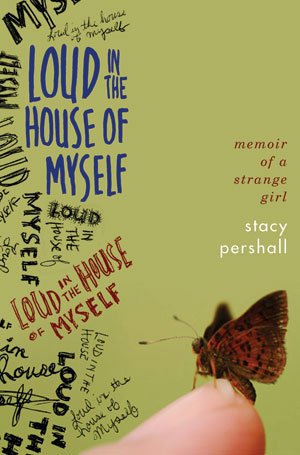
Loud In the House of Myself: Memoir of a Strange Girl is a new book by Stacy Pershall. Of course, I was immediately drawn to this memoir, because it is a) a memoir b) about a “strange girl” and c) deals with mental illness. Yay! Since I’m undoubtably a strange mentally ill girl, I knew I had to read this. Pershall writes about her life growing up in Arkansas and her morphing from an über-sensitive child into a teenager and young adult with Borderline and Bipolar issues. Anyone familiar with the mental illness memoir genre will certainly have heard of Elizabeth Wurtzel, and I just bring her up, because UNLIKE Wurtzel, Pershall is not whiny in her writing! Pershall is matter-of-fact about her trials and symptoms, even though the reader can imagine the actual playing out of illness to be much more harsh and unbearable.
Pershall describes her unrelenting eating disorder, mood swings and suicide attempts with a steady and precise hand. This book seems really accessible to me, because Pershall speaks not only to those of us who have been through the mental health care system, but also to people who might not really understand this special weirdness. The only thing I would like to see more of in this book is more OF this book! haha. Seriously though, I enjoyed reading this memoir and would love to read more from Pershall. I would especially recommend this book to people struggling with Borderline Personality Disorder. There is a special misery only known by Borderlines that is never really represented in the books that ostensibly deal with Borderline Personality Disorder. I really wish there were more accounts like this that show the uncrazy through the crazy of Borderline Personality Disorder.

 ) I might owe my fast reading of this book to my Starbucks coffee run, but it could also be attributed to the good and interesting writing in this book. “Buzz: The Science and Lore of Alcohol and Caffeine” by Stephen Braun is a captivating discourse on two of the most beloved substances on the planet. At one moment you are a molecule-sized scuba diver following the path of the ethanol molecule throughout the body and the next you are sizing up the athletic advantages of caffeine. The first half of the book is dedicated mainly to alcohol and its effects on the body and brain. The second half discusses caffeine. While the book may be a bit outdated (published in 1996), it still has relavent information for lay readers interested in how caffeine and alcohol work in the human body. The book really left me wanting to know more of the unanswered questions about how these substances work on a microscopic/molecular level. I felt that the first half covering alcohol was more complete, and ultimately more interesting, than the caffeine part, which is why I give this book 4 stars instead of 5. A good read nonetheless and you will come away probably knowing more than you do now about alcohol and caffeine.

 )
)
 )
)
 kristinbell.org