The Haldol Injections: After 10+ Years

2012, Anti-psychotics, Denial, Haldol, Haldol DEC, Haldol Decanoate, insanity, Kristin Bell, Lunatic, Medicine, Mental Health, Mental Illness, neurotransmitters, Psych Meds, Psychiatrist, Psychiatry, Psychiatry Denial, Psycho, Psychoactive Substances, Psychology, Psychosis, schizoaffective disorder, Schizophrenia

I first wrote about taking my Haldol injections back in 2007 in https://kristinbell.org/2007/07/23/the-haldol-injections/.

I wanted to report that yes, I’m still getting the Haldol injections now once every three weeks. Haldol is an antipsychotic medication used to treat psychosis like that found in schizophrenia. I have schizophrenia and started getting the Haldol injections back in late 2000…I guess it was November or December of 2000. The Haldol injections combined with all the other meds I take have been a miracle for me.

So far (knock on wood) I haven’t had many side-effects from the medication. I haven’t yet developed tardive dyskinesia. I hope that I don’t.

I had to start getting the Haldol injections, because I couldn’t take my medications as prescribed. It sounds like a simple enough task, but my illness got in the way of me adhering to my medication regiment, and I’d wind up going off my meds and going crazy. I’ve had a good run with the Haldol. I haven’t been hospitalized since starting it, and if you know anything about people with mental illness, that is quite a feat! :) Without the injection form of the medication I’m pretty sure I’d still be bouncing in and out of insanity and in and out of hospitals.

Haldol is a powerful medication, and not one that people enjoy taking. It can cause a lot of sedation, but in the right dose with the right brain it is a miracle drug. It doesn’t work for everyone, and I probably wouldn’t extoll the virtues of it if I was taking the oral form of the medication. With the injection form of the medication I am able to take less of the medication while still getting the benefits of it. I believe that there are also short-acting Haldol injections for acutely psychotic patients, but I am getting the long-acting injections which metabolize over a number of weeks.

I know that a lot of people, including people with schizophrenia and other brain diseases, are afraid of getting injections of medication. If you are paranoid and psychotic, like I was when I first got the injection, it is terrifying to get the injections. I actually believed that the doctors were giving me a lethal injection to kill me when I got my first dose. It turns out that it was the best thing that ever happened to me, not the worst. Now there are other medications that come in injection forms too. Meds like Risperdal and others. If Haldol doesn’t work for someone then maybe one of the other injectables will work. At any rate, I think it is worth giving them a try. It may take awhile to get used to the meds and to get the correct dosing, but it is worth it in the end.

Mental Health Update: Monday, May 28, 2012

2012, Abilify, Acceptance, Anti-anxiety meds, Anti-depressants, Anti-psychotics, Anxiety, Autobiography, Bipap, Body Image, Body Narrative, Brain, Buspar, Depression, Diary Rant, EDNOS, Fat, Fat Acceptance, Fat Hatred, Haldol, Haldol DEC, Haldol Decanoate, Happy, Health, Injections, insanity, Kristin Bell, Medicine, Mental Health, Mental Illness, Mood Stabilizers, Prescription Meds, Psych Meds, Psychiatrist, Psychiatry, Psychiatry Denial, Psycho, Psychoactive Substances, Psychology, Psychosis, schizoaffective disorder, Schizophrenia, Sleep, Sleep Disorders, stigma, Weight, Zoloft

I thought I’d do a little mental health update, since it has been quite some time since I’ve blogged about my overall mental health. As some of you dear readers may know, I have schizophrenia. I first had issues with it when I was about 15. My first hospitalization was when I was 16. Towards the end of 2000 I got mostly stabilized with my Haldol injections and Zoloft. I haven’t been in the hospital since then! Yay! Quite a long run I’ve had and I hope it continues! For quite some time I had problems getting things done, being motivated and feeling down…that sort of thing, even though I was mostly fine. I think it was last year that I started taking Abilify and it has made a HUGE difference! I’m still taking Zoloft, Buspar, Haldol and some non-psychiatric meds in addition to the Abilify, but the addition of the Abilify was great. I’m doing really pretty well these days. Sometimes I have anxiety, although I think it might generally be related to performance issues with school. I also tried taking Topamax to help with weight loss, but I thought it might be making me stupid and giving me more anxiety, so I quit taking it. I think overall, the Topamax was not helping. It seemed like I was becoming less motivated and more sad with it. I also had that bad anxiety day that I wrote about recently.

So, I think I was just hoping for a magic weightloss bullet with the Topamax. It didn’t work. Boo. I have lost about 90-100 pounds though which is good, but I still need to be less sedentary. I’m also a believer in fat acceptance, but of course it is hard to say that I never want to try to lose weight. I would be an even bigger believer in fat acceptance if I wasn’t actually fat I think!!! hahaha. I know that sounds ridiculous, but it is kind of true. I can accept the hell out of everyone’s fatness, but my own! lol.

Anyway, enough about fatness for now. What I want to say is that I’m doing well on the whole. My sleep patterns have improved with my sleep apnea machine, and while I’m not sleeping on any kind of normal schedule yet, I’m getting sleep every day and mostly at the same time! I still tend to be somewhat paranoid, but I’ve found that opening up with people over the years on the internet has really helped me to realize that I don’t need to be afraid of everyone in the world. I still have some delusional thoughts that blow through my brain now and then, but I consider them to be more of a slight annoyance than a big deal right now. But seriously, it is because of the medicine. If I wasn’t taking my meds, and doing so faithfully, I would be in and out of hospitals and massively psychotic. Some people don’t believe me, because I “seem so normal,” but I have to wonder what THAT means anyway? And, I don’t know, it seems like I should be insulted when people say that to me, but I’m not sure why I find it so insulting! I don’t necessarily want to be abnormal, even though I pretty much am, but I think it just bothers me that people attach a kind of value judgement to the term “normal” as if “normal” is superior. It is definitely easier to live in the world if you are “normal,” but it isn’t the only way to be in the world, that’s for sure. Normal is just such a peculiar word, no?

So, I’m doing fine. Some anxiety here and there, some weird thoughts here and there…a depressed mood now and then, but mostly just good. Which is nice. Thank you meds and thank you lucky stars! So, that’s my update after living with schizophrenia for 24 years. Wow! 24 years! Man am I getting old!!! LOL.

New Abstract Art by Me + Discussion

abstract art, Art, art journal, Autobiography, Bipolar, Borderline Personality, BPD, DBT, Depression, drawings, EDNOS, Handmade, Hope, Illustrated, insanity, iPad, iPad Art, journal, Kristin Bell, Marsha Linehan, Memory, Mental Health, Mental Illness, Mindfulness, pain, Painting, Photography, process, Prozac, Psych Meds, Psychiatrist, Psychiatry, Psychiatry Denial, Psychoactive Substances, Psychology, Sculpture, Self-Harm, Self-Injury, sketchbook, Stress, Suicide, Support System, Surviving

Process:
I was reading a book by Marsha Linehan, the creator of Dialectical Behavior Therapy treatment for people with Borderline Personality Disorder, and I was struck by the theoretical concepts that she was discussing in the book. At the same time, I had been thinking about my friend who has BPD. I thought about the unending pain she suffers and how there is so much rage and turmoil in her life. I wanted to incorporate both Linehan’s concepts and aspects of my friend into the art journal that I just started working on as a collaboration with my friend, John.

So, John began the journal by preparing many pages and providing inspirations and prompts, then he mailed it to me and it was my turn to lay down something on the pages.

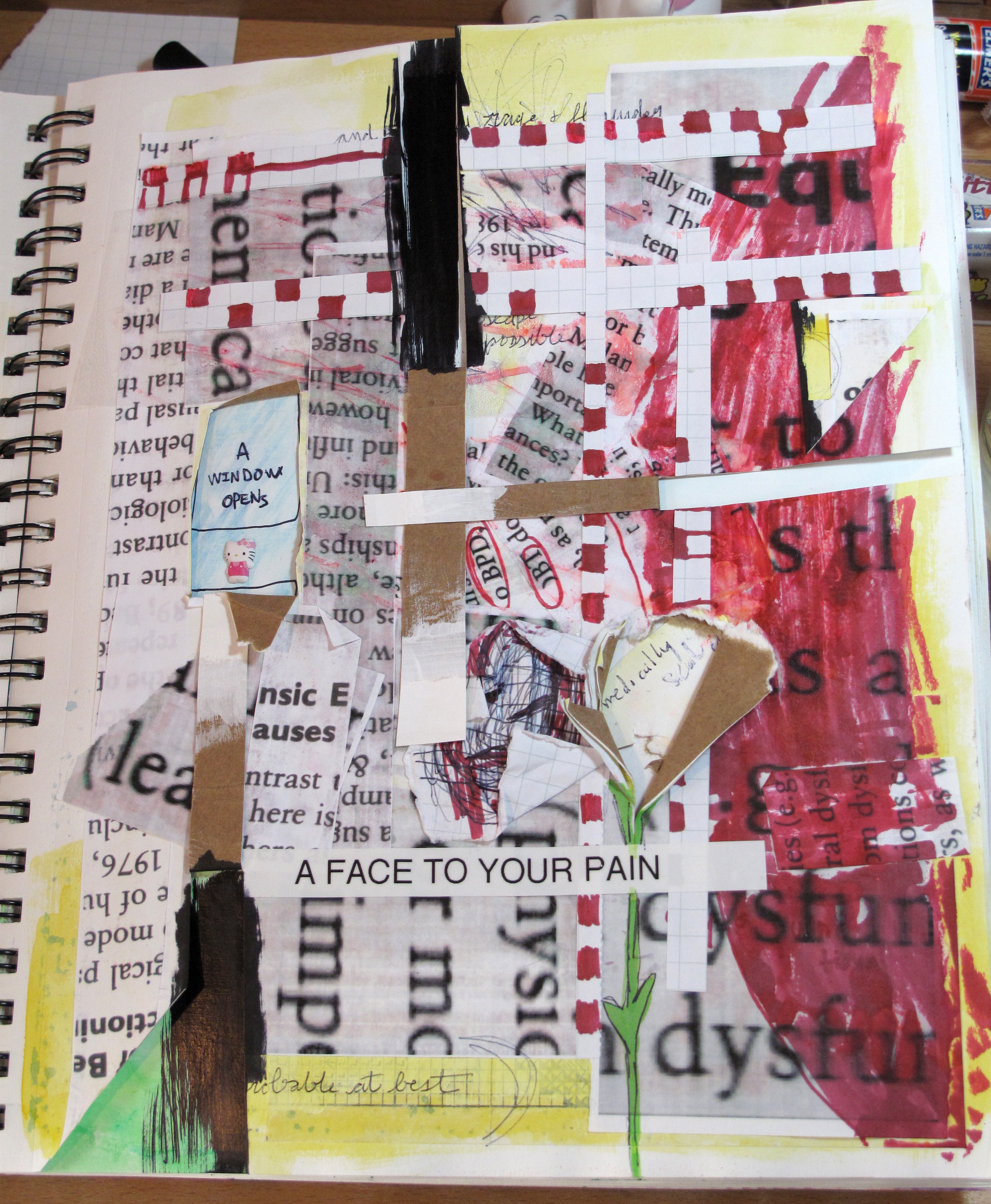
The first thing I did was use a handheld scanning pen to scan vertical snippets of text from the Linehan book. I then printed out the scans and cut them up into various pieces. You can just make out some of the text, like the words “dysfunction” and “BPD” and “DBT” if you look closely at the first piece.

Next, I began by glueing down the various text scans onto the journal…all over the top of what my friend John had already done. You can see bits of the yellow wash that he had laid down already. I added handwritten elements with text that expressed how I felt about my friend with BPD. Some are “rage and flounder,” “escape impossible,” “improbable at best,” and “hermedically sealed” (which I spelled wrong, but ends up being seen as “medically sealed” in the final product which I think is just as good and apt).

I colored over parts with a reddish pen, because for me, reddish colors always seem to represent pain and suffering, if not outright blood. I also used my label maker to add “A FACE TO YOUR PAIN,” because I felt like this was my way of giving her pain a face. There is also a scrunched up scribble of a face contorted with pain on the journal page just above the label. Then I started adding layers of cut out graph paper, because I wanted part of the image to have some linear and quantifiable aspects, like the discreet squares of red in contrast to the smudgy blob of red elsewhere. I also added a cut out plastic sleeve that I applied color to.

I then decided that I wanted to cut out some of the page and expose the treatment that was done on the other side of the page by my friend John. I likened this to an escape hatch to relieve the immense pressure and pain of the page and my friend’s actual pain. I cut out “hermedically sealed,” which is how it seems my friend’s pain is stored, and I pasted it onto the next page so that it could be seen as “medically sealed” through the cutout. A lot of my friend’s history involves intense and traumatic encounters with the medical establishment, so I thought this was appropriate. I cut out and folded over some of the page to make more linear elements and to add to the color use on the page as well. I also wanted to do this to incorporate the idea of overlapping aspects of our lives and our histories.

When I cut out “hermedically sealed” it left an opening that for me seemed like a window and represents the hope I still have for my friend despite what seems like endless suffering. I painted the page that can be seen underneath with blues and greens to represent the sky and grass, and I placed a puffy Hello Kitty sticker in the window as a kind of whimsical “hello” with friendship. Part of the other cutout seemed organic and flower-like to me, so I also added a stem of a flower for more aspects of light and living, but also change and death. With some of the folded over cutouts I felt like there was too much color and light, so I blacked out the spaces with a magnum black Sharpie.

Throughout the process, I was concerned not only with symbolic aspects of representation, but also with the aesthetic elements of line, color, space, balance, etc. So, part of the experiment was definitely symbolic, but I also spent time adjusting the image elements to try to make an interesting and unifying picture.

When I felt like I was done with the journal page, I took a photograph of it and posted it to Facebook to keep track of the process aspect of the journaling project. I was then compelled to go further with the image by enlarging parts of the image and cropping them in interesting ways. I took snapshots of the screen with my iPad and then emailed them to my desktop machine where I processed them in Photoshop and then printed them out. I really didn’t know how they would look printed out or if I would use or like them at that point.

I liked how the prints looked, but I felt they really should be juxtaposed somehow, so I combined them.

The closeup crops that I made were deliberate. I based my decisions on aesthetics and also on what words would be incorporated into the image. “A FACE TO YOUR PAIN” was cropped into “TO YOUR PAIN” for one image and “OUR PAIN” for another image. I wanted to bring together these two aspects of the experience of pain, the self and the other, and comment on the interaction between the two. For my friend who suffers, it seems that her pain is hers alone and that it is an isolated state of suffering, but she also has friends, family and care providers who care about her and interact with her pain and suffering. We, of course, have our own pain and suffering, but seeing her in pain is also difficult and informs our own pain and our own worldview.

When I combined the crop prints, I was “mindful” of the tension between the different images on the page and wanted to incorporate Linehan’s ideas about thesis, antithesis and synthesis in the overall picture. For me, the synthesis is the final completed work, but up until then I felt that I was going back and forth trying to find the finished piece. I felt that I needed to bridge the piece to make it more cohesive, so I added a red ribbon that tied the gaps that I saw together, also tying my friend to the world and people outside of herself. I then added sculpted copper wire to put back in a bit of the organic that I thought was lost and to act as a core and a crowning jewel.

For the second image, I employed much the same process. I printed out crops of the journal and then cut and fit the pieces together like a puzzle. For me, the second piece is more about hope, so I used the “A Window Opens” text in part of it and the overall image is less dark and red. The border of the image is a handwritten excerpt from Linehan’s text that talks about dialectics and how it is a process that persuades and encourages movement. I used the red yarn to imply some movement, but also tension. The yarn is tight, but not so tight that it tears the page. It also helps to unify the image I think, adding that aspect of synthesis.

The journal page.
The first finished piece.The second finished piece.

Review: Loud In the House of Myself by Stacy Pershall

Acceptance, Anorexia, Anti-anxiety meds, Anti-depressants, Anti-psychotics, Anxiety, Ativan, Autobiography, Binge Eating, Bipolar, Black & White, Body, Body Image, Books, Borderline Personality, Bulimia, Compulsive Eating, Compulsive Exercising, Depakote, Depression, Eating Disorders, EDNOS, insanity, Internet, Kristin Bell, Lithium, Loud In the House of Myself, Mania, Manic, Manic-Depressive, MAO Inhibitors, memoir, Mental Health, Mental Illness, Mood Stabilizers, Navane, Prozac, Psych Meds, Psychiatrist, Psychiatry, Psychoactive Substances, Psychology, Reading, Review, Self-Harm, Self-Injury, Stacy Pershall, Stories, strange girl, Suicide, Surviving, Thin, Weightloss

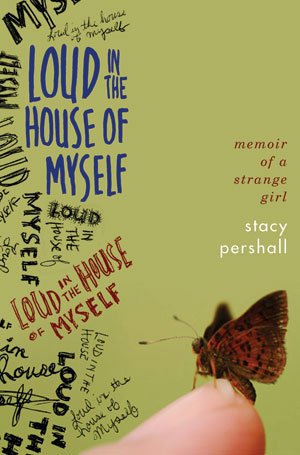
Loud In the House of Myself: Memoir of a Strange Girl is a new book by Stacy Pershall. Of course, I was immediately drawn to this memoir, because it is a) a memoir b) about a “strange girl” and c) deals with mental illness. Yay! Since I’m undoubtably a strange mentally ill girl, I knew I had to read this. Pershall writes about her life growing up in Arkansas and her morphing from an über-sensitive child into a teenager and young adult with Borderline and Bipolar issues. Anyone familiar with the mental illness memoir genre will certainly have heard of Elizabeth Wurtzel, and I just bring her up, because UNLIKE Wurtzel, Pershall is not whiny in her writing! Pershall is matter-of-fact about her trials and symptoms, even though the reader can imagine the actual playing out of illness to be much more harsh and unbearable.

Pershall describes her unrelenting eating disorder, mood swings and suicide attempts with a steady and precise hand. This book seems really accessible to me, because Pershall speaks not only to those of us who have been through the mental health care system, but also to people who might not really understand this special weirdness. The only thing I would like to see more of in this book is more OF this book! haha. Seriously though, I enjoyed reading this memoir and would love to read more from Pershall. I would especially recommend this book to people struggling with Borderline Personality Disorder. There is a special misery only known by Borderlines that is never really represented in the books that ostensibly deal with Borderline Personality Disorder. I really wish there were more accounts like this that show the uncrazy through the crazy of Borderline Personality Disorder.

Go All the Way or Go Home: Name-calling in the Media

Acceptance, Arizona, Bipolar, Culture of Violence, Denial, Discrimination, Ethics, Gabrielle Giffords, gunman, Guns, Hate, insanity, Kristin Bell, Lunatic, Mental Health, Mental Illness, Nutcase, Psychiatry, Psycho, Psychosis, rhetoric, Schizophrenia, shooting

I seem to be one of the few liberal-ish people who thinks that the Arizona shooting had more to do with mental illness than politics, and I think it is kind of ironic that a great majority of the Left is talking about “dangerous” rhetoric while simultaneously throwing pejoratives about mental illness and the mentally ill around like “crazy.” Everything from “nutter” to “nutjob” to “lunatic,” “crazies,” “wacko” and every other euphemism for the mentally ill that you can think of—except a plain “mentally ill.” If the Left is really so worried about a culture of bad rhetoric, then I say they should go all the way or go home. In other words, stop calling mentally ill people disrespectful names (of course, the Right is rampant with this too). This kind of vilification of the mentally ill does exactly what the Left is talking about the rhetoric of gunning people down does—it objectifies people and dismisses their humanity. But, I guess that it is okay to diss the crazies, because we aren’t really people afterall are we? We are just wild animals that need to be chained and shot for the good of everyone. Well, that is what a lot of people seem to believe, especially when something tragic happens like the shooting in Arizona. What happened in Arizona was wrong and awful, but despite peoples’ desires to paint the tragedy into black and white terms where there is good on one side and evil on another, in reality the good and evil don’t exist. They are words we’ve made up to downplay and deny the complexities of situations that we have a difficult time understanding. We can do better.