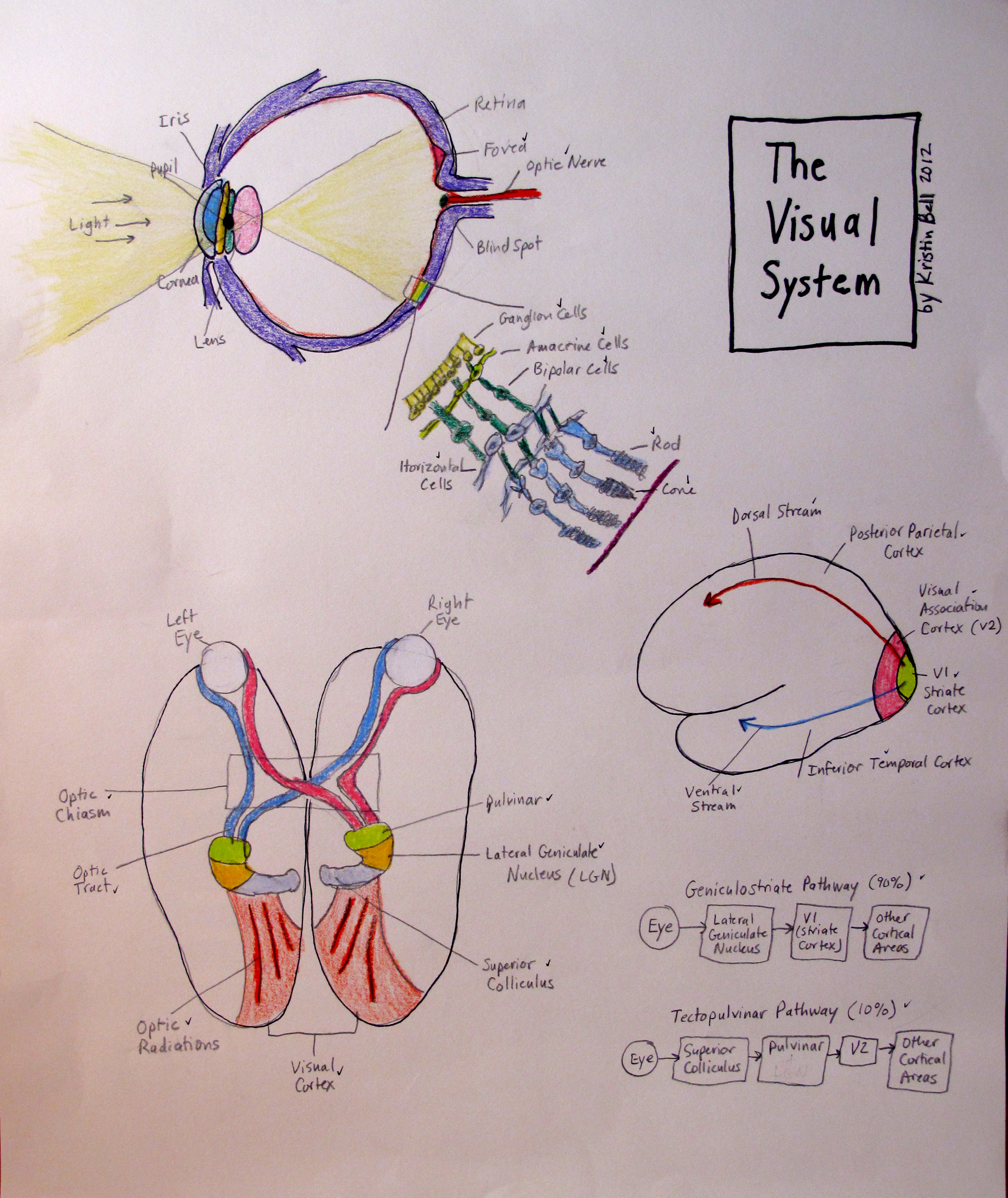
I didn’t have time to do a complete job on this one, but I got it done! lol To see a bigger image, just click on the picture.

I didn’t have time to do a complete job on this one, but I got it done! lol To see a bigger image, just click on the picture.
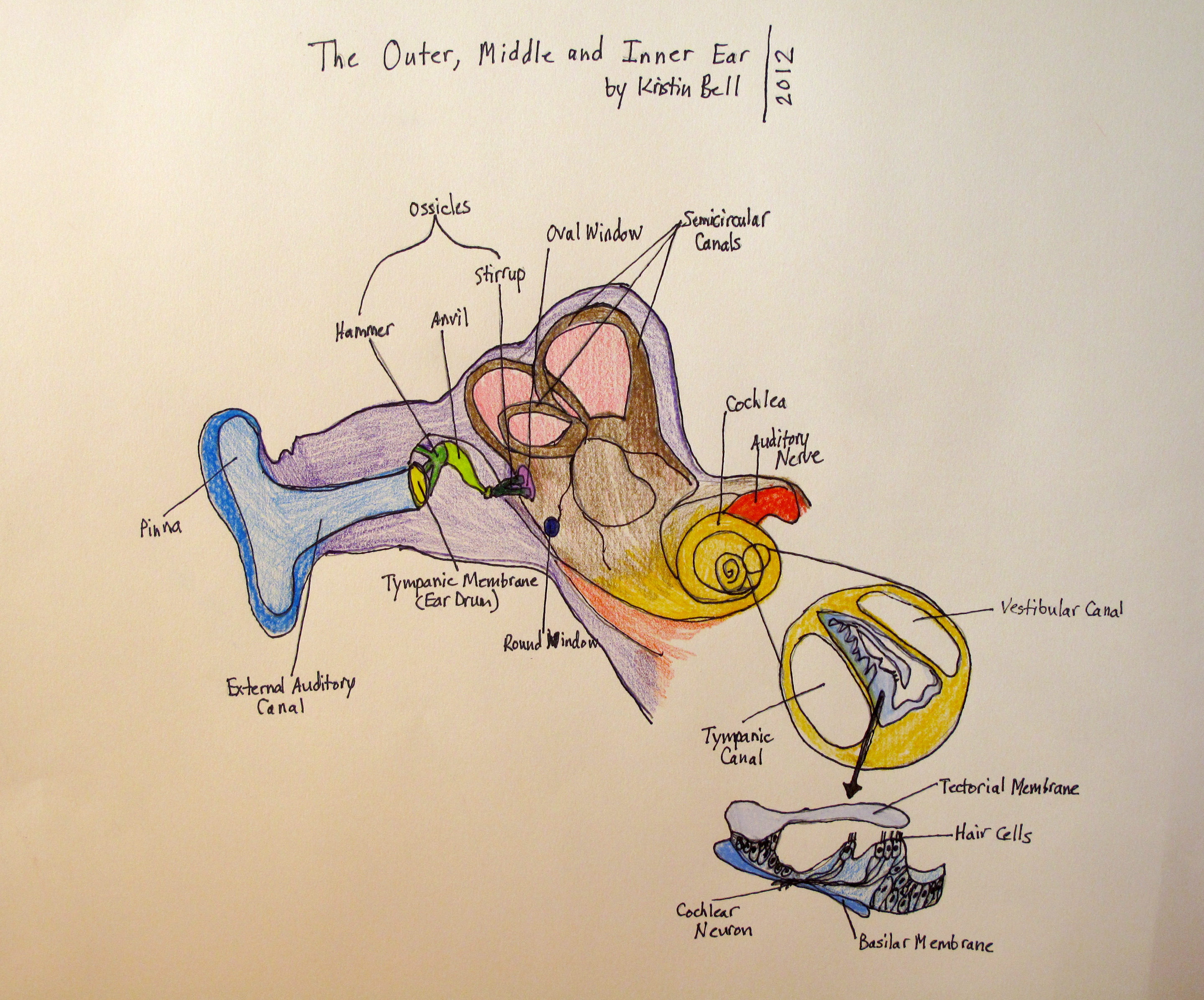
This last week we were learning about the auditory system in neuroscience class. These are the drawings I came up with for the assignment we had to do. He said that they didn’t have to be anatomically correct and could be schematic, so the second picture is more of a schematic drawing.

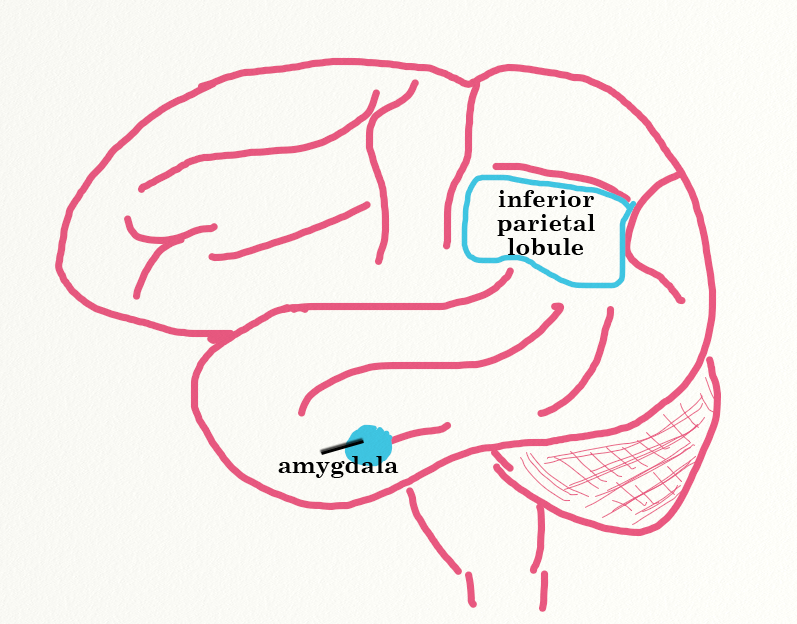
As reported in Schizophrenia Research, vol. 134 (2012) 118-124, Prerona Mukherjee et. al. presented their study that showed lower connection activity levels from the amygdala to the rest of the brain, specifically, to the inferior parietal lobule, for people with schizophrenia as compared to controls. The study involved 19 participants diagnosed according to the DSM-IV with schizophrenia and 24 controls matched for demographics like educational level, region, and age.
The study involved pre-assessment of symptoms and scanning the participants with an fMRI machine while they were shown fearful, neutral and baseline faces. Data was collected and analyzed showing that the participants with schizophrenia displayed reduced connectivity when shown fearful faces. The regions that were implicated involve social-emotional processing that is vital to social interactions.
The study supports the view that there may be a “functional disconnection” in brain regions that support and interpret social cues and emotion processing information for people with schizophrenia. This information also mirrors the symptoms that many patients with schizophrenia present with such as paranoia, flattened affect and lack of correct social cue processing.

A study performed by Hui-jie Li et. al. based in Beijing, China and published in Schizophrenia Research vol. 134 (2012) tested 12 patients with schizophrenia for facial emotion processing. In the study, 12 of the non-ill siblings of the patients were also tested along with a control group of 12 people who were matched for demographic variables like IQ, age, gender, and education levels.
The researchers were especially interested in evaluating whether or not the patients with schizophrenia had deficits in facial emotional processing like other studies from Western populations have indicated. In essence, this was a replication study paired with a cultural component to test if facial emotional processing deficits are universal or not.
The data obtained from 8-minute fMRI scanning sessions where participants were shown 20 happy faces, 20 fearful faces and 20 neutral faces (at different times with different time intervals) were analyzed and it was found that the patients with schizophrenia showed abnormal activation of the “social brain neural circuit.” In addition, the sibling participants showed slight abnormalities that fell between what the patients with schizophrenia displayed and what the control group displayed. This result led researchers to hypothesize that there might be a deficit even in the non-ill siblings that the patients’ brains are trying to compensate for.
During the study the control group showed greater activation in various brain regions that processed the happy faces, but the patients with schizophrenia showed greater activation than the controls in the left middle frontal gyrus when processing the fearful faces. The sibling participants also showed greater activation than the controls (but less than their siblings with schizophrenia) when processing fearful faces, but had similar activation responses to controls with the happy faces.
The results of the study are similar to previous studies done to test for facial emotional processing in people with schizophrenia indicating that there are universal deficits in facial emotional processing that patients with schizophrenia must compensate for.
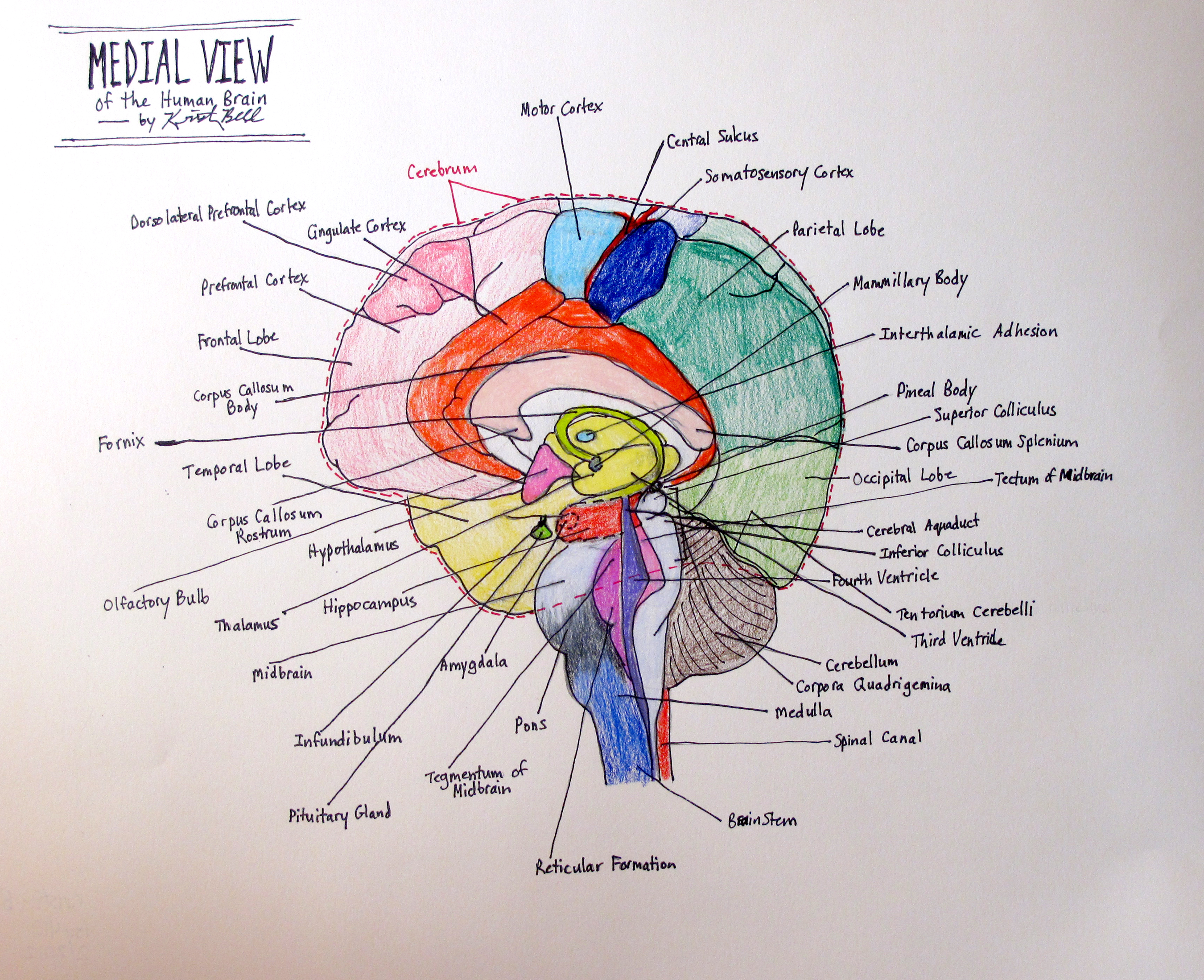
I’m not quite sure if I got all of the parts in the right spots for this one. It is pretty hard to draw from multiple images and get everything in one pic. This is supposed to be the medial view of the human brain. :) Click the pic to enlarge.
For my interactive Medial Brain, click here!


This is the 4th pic for my neuro class. It is a drawing of the lateral human brain with only some of the parts. These are the parts we had to label. :) You can click the picture for a larger view. NOTE: The orbitofrontal cortex was mis-labeled in this picture. It should be on the anterior part of the frontal lobe! So, I deleted the old pic and now this new one has whiteout on it. Oh well! Live and learn! :)
For my interactive Lateral Brain, click here!


Here is my second drawing for neuroscience class. It is a picture of the synaptic gap basically and shows ionotropic and metabotropic receptors and other brain stuff. lol. :)
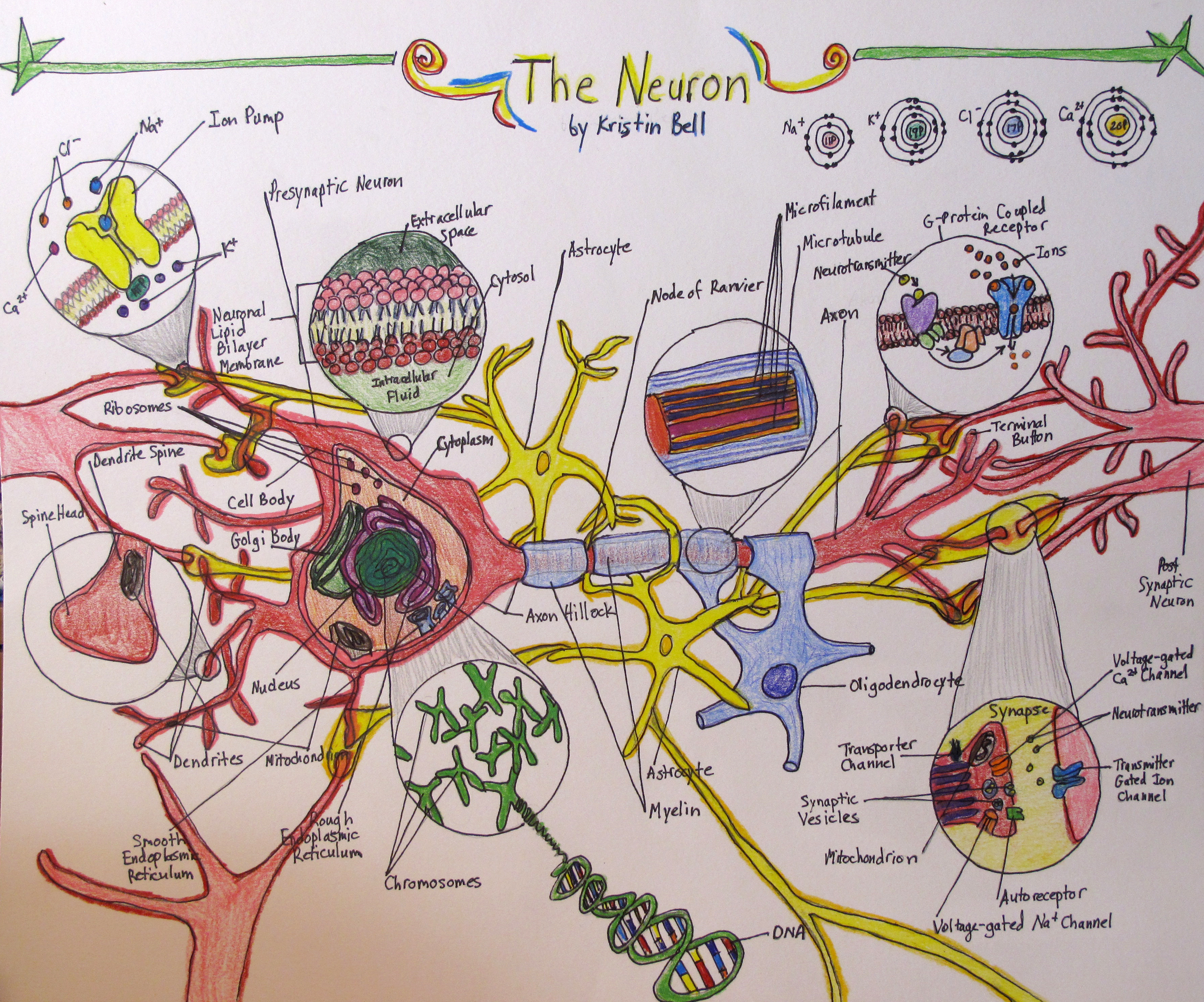
I had to draw the neuron and its parts for my neuroscience class. Here is what I made! Click the pic for a larger view. :) NOTE: I had to change my picture a bit, because I didn’t have the astrocytes connecting to the synapses. I also added a few other things. It is a little more crowded now, but I guess more correct. Another NOTE: I deleted the first two pics because they had mistakes. Here is the final version which may also have mistakes, but I think it is the most correct version. :)

I’m very pleased to report that this last term at school went great! I took the first term of Calculus and Intro. to Linear Algebra and got A’s in both classes! I also had a really good time with the classes. I had great teachers too! I have seen a real improvement in my ability to actually get to classes because of my bipap sleep machine and have seen an even greater increase in my ability to do homework and concentrate since I started taking Abilify last January. Doing well in school has always been important to me, but because of my schizophrenia and sleep problems I have had a lot of issues with being able to attend and get through classes.
When I first became ill when I was 15 my grades really suffered. For the first time in my life I wasn’t a straight A student which was quite disheartening. The last two terms in school I have been feeling a lot like my old self for the first time since I was 15!!!
Anyway, this last term was great and a real ego booster! I just hope I can keep up the success! :)
Process:
I was reading a book by Marsha Linehan, the creator of Dialectical Behavior Therapy treatment for people with Borderline Personality Disorder, and I was struck by the theoretical concepts that she was discussing in the book. At the same time, I had been thinking about my friend who has BPD. I thought about the unending pain she suffers and how there is so much rage and turmoil in her life. I wanted to incorporate both Linehan’s concepts and aspects of my friend into the art journal that I just started working on as a collaboration with my friend, John.
So, John began the journal by preparing many pages and providing inspirations and prompts, then he mailed it to me and it was my turn to lay down something on the pages.
The first thing I did was use a handheld scanning pen to scan vertical snippets of text from the Linehan book. I then printed out the scans and cut them up into various pieces. You can just make out some of the text, like the words “dysfunction” and “BPD” and “DBT” if you look closely at the first piece.
Next, I began by glueing down the various text scans onto the journal…all over the top of what my friend John had already done. You can see bits of the yellow wash that he had laid down already. I added handwritten elements with text that expressed how I felt about my friend with BPD. Some are “rage and flounder,” “escape impossible,” “improbable at best,” and “hermedically sealed” (which I spelled wrong, but ends up being seen as “medically sealed” in the final product which I think is just as good and apt).
I colored over parts with a reddish pen, because for me, reddish colors always seem to represent pain and suffering, if not outright blood. I also used my label maker to add “A FACE TO YOUR PAIN,” because I felt like this was my way of giving her pain a face. There is also a scrunched up scribble of a face contorted with pain on the journal page just above the label. Then I started adding layers of cut out graph paper, because I wanted part of the image to have some linear and quantifiable aspects, like the discreet squares of red in contrast to the smudgy blob of red elsewhere. I also added a cut out plastic sleeve that I applied color to.
I then decided that I wanted to cut out some of the page and expose the treatment that was done on the other side of the page by my friend John. I likened this to an escape hatch to relieve the immense pressure and pain of the page and my friend’s actual pain. I cut out “hermedically sealed,” which is how it seems my friend’s pain is stored, and I pasted it onto the next page so that it could be seen as “medically sealed” through the cutout. A lot of my friend’s history involves intense and traumatic encounters with the medical establishment, so I thought this was appropriate. I cut out and folded over some of the page to make more linear elements and to add to the color use on the page as well. I also wanted to do this to incorporate the idea of overlapping aspects of our lives and our histories.
When I cut out “hermedically sealed” it left an opening that for me seemed like a window and represents the hope I still have for my friend despite what seems like endless suffering. I painted the page that can be seen underneath with blues and greens to represent the sky and grass, and I placed a puffy Hello Kitty sticker in the window as a kind of whimsical “hello” with friendship. Part of the other cutout seemed organic and flower-like to me, so I also added a stem of a flower for more aspects of light and living, but also change and death. With some of the folded over cutouts I felt like there was too much color and light, so I blacked out the spaces with a magnum black Sharpie.
Throughout the process, I was concerned not only with symbolic aspects of representation, but also with the aesthetic elements of line, color, space, balance, etc. So, part of the experiment was definitely symbolic, but I also spent time adjusting the image elements to try to make an interesting and unifying picture.
When I felt like I was done with the journal page, I took a photograph of it and posted it to Facebook to keep track of the process aspect of the journaling project. I was then compelled to go further with the image by enlarging parts of the image and cropping them in interesting ways. I took snapshots of the screen with my iPad and then emailed them to my desktop machine where I processed them in Photoshop and then printed them out. I really didn’t know how they would look printed out or if I would use or like them at that point.
I liked how the prints looked, but I felt they really should be juxtaposed somehow, so I combined them.
The closeup crops that I made were deliberate. I based my decisions on aesthetics and also on what words would be incorporated into the image. “A FACE TO YOUR PAIN” was cropped into “TO YOUR PAIN” for one image and “OUR PAIN” for another image. I wanted to bring together these two aspects of the experience of pain, the self and the other, and comment on the interaction between the two. For my friend who suffers, it seems that her pain is hers alone and that it is an isolated state of suffering, but she also has friends, family and care providers who care about her and interact with her pain and suffering. We, of course, have our own pain and suffering, but seeing her in pain is also difficult and informs our own pain and our own worldview.
When I combined the crop prints, I was “mindful” of the tension between the different images on the page and wanted to incorporate Linehan’s ideas about thesis, antithesis and synthesis in the overall picture. For me, the synthesis is the final completed work, but up until then I felt that I was going back and forth trying to find the finished piece. I felt that I needed to bridge the piece to make it more cohesive, so I added a red ribbon that tied the gaps that I saw together, also tying my friend to the world and people outside of herself. I then added sculpted copper wire to put back in a bit of the organic that I thought was lost and to act as a core and a crowning jewel.
For the second image, I employed much the same process. I printed out crops of the journal and then cut and fit the pieces together like a puzzle. For me, the second piece is more about hope, so I used the “A Window Opens” text in part of it and the overall image is less dark and red. The border of the image is a handwritten excerpt from Linehan’s text that talks about dialectics and how it is a process that persuades and encourages movement. I used the red yarn to imply some movement, but also tension. The yarn is tight, but not so tight that it tears the page. It also helps to unify the image I think, adding that aspect of synthesis.
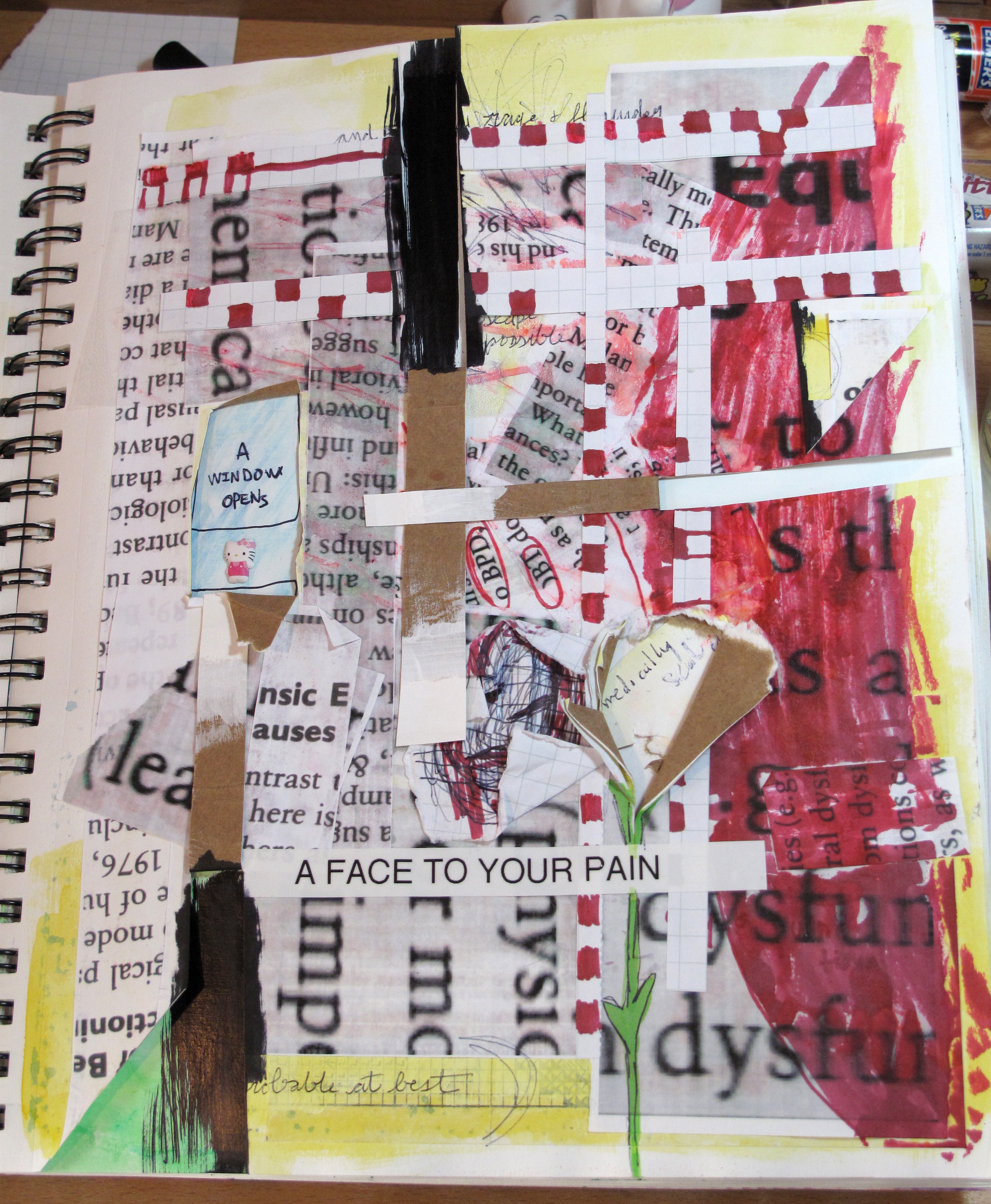 The journal page.
 The first finished piece.
 The second finished piece.
 kristinbell.org